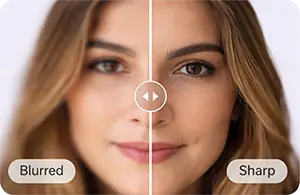
AI Sharpening Basics
How to sharpen low-res images without halos or crunch?

TL;DR
- Do not sharpen first by default. Low-res images often need diagnosis, cleanup, and sometimes upscaling before any sharpening pass.
- Halos come from broad, aggressive edge contrast. Crunch usually comes from sharpening noise, JPEG blocks, or skin texture too hard.
- For tiny files, upscale before final sharpening. For full-size but slightly soft files, use light sharpening with a small radius.
- Judge the result at 100% zoom. If faces look brittle, text gets thicker, or bright outlines appear, back off.
- PhotoSharpener is useful when you want one browser workflow that can clean compression damage, upscale small files, and finish with restrained sharpness.
If you want to sharpen low-res images without halos or crunch, the biggest mistake is treating every soft-looking file as a sharpening problem.
Small images usually fail in more than one way at once. They may be undersized, slightly blurry, noisy, or full of JPEG damage from messaging apps and repeated saves. When you hit those files with a strong sharpen slider, the software does what it was built to do: it exaggerates edge contrast. That can make a preview look punchier for a second, but it also creates glowing outlines, rough skin, thicker text, and that brittle "crunchy" look people hate.
The safer approach is to diagnose the file first, fix the real bottleneck, and then sharpen only as a finishing step if the image still needs it. That sounds slower, but in practice it saves time because you stop fighting artifacts that were introduced by the wrong first move.
Diagnose the problem before you sharpen
Low resolution and blur are not the same problem
A low-res image is missing pixels. A blurry image has pixels, but the edges and textures inside them are soft. Some files are both, but many are mostly one or the other.
That distinction matters because sharpening only boosts contrast around existing edges. It does not create real resolution. Adobe's explanation of Unsharp Mask says this clearly: sharpening creates the illusion of more detail, not new detail that was never recorded.
Use this quick diagnosis before you touch any controls:
| What you see | What is probably wrong | Better first move |
|---|---|---|
| Small file that falls apart when enlarged | Too few pixels | Upscale first |
| Full-size image that looks slightly dull | Mild softness | Light sharpening |
| Rough grain, blocks, or smearing in flat areas | Noise or JPEG damage | Clean artifacts first |
| Subject streaked sideways | Motion blur | Use a deblur tool or accept limits |
If you skip this step, you usually end up using sharpening as a rescue tool for a problem it cannot actually solve.
Noise and JPEG damage create fake detail
This is where halos and crunch often begin. Noise, compression blocks, and ringing artifacts look like tiny edges to a sharpen filter. So the filter boosts them right along with the useful detail.
That is why low-light phone shots, screenshots, and chat-app downloads get ugly so fast when over-sharpened. The tool is not being "stupid." It is following the signal it sees, and the signal is already dirty.
When the image has obvious grain or compression damage, think of sharpening as a last step, not a repair step.
Choose sharpening or upscaling based on the file
When light sharpening is enough
Sharpening is enough when the file already has reasonable dimensions for the final use and only needs a little edge definition. Typical examples are:
- a product image that looks slightly soft after export
- a scan with mild softness but decent pixel dimensions
- a portrait that feels flat rather than truly blurry
- a screenshot that is readable but not crisp
In those cases, a small, careful sharpening pass can work well because the image already contains most of the structure you need. You are finishing the file, not forcing new detail into it.
This is also the safest use case for older tools like Unsharp Mask, Smart Sharpen, or High Pass sharpening. The more intact the source is, the less likely you are to get harsh edge artifacts.
When upscaling should come first
If the image is genuinely small for the job, sharpening first usually makes it look worse. You get sharper-looking pixels, but they are still the wrong pixels for the size you need.
Upscaling should come first when:
- the image is a thumbnail, avatar, crop, or messaging-app download
- you need a larger on-screen display size
- you plan to print the file larger than its current dimensions can support
- faces or text are too small to inspect cleanly
That is why the sharpen-vs-upscale choice matters so much. If you want a fuller breakdown, our guide on AI upscaling vs normal sharpen filters explains how each tool behaves and when the order should change.
Build a workflow that avoids halos from the start
Clean noise before you add edge contrast
If the photo is noisy, grainy, or full of JPEG damage, clean that first or use a tool that handles cleanup and reconstruction together. Otherwise the sharpen pass treats that mess as detail and locks it in.
This order works well for most weak files:
- inspect the image at 100% zoom
- reduce obvious noise or compression damage
- upscale if the file is too small
- add only light final sharpening if the result still feels soft
That sequence matters because each step prepares the next one. If you reverse it and sharpen before cleanup, halos become harder to remove later.
Resize or upscale to the final size before output sharpening
This is one of the most reliable anti-halo rules in image editing. Final sharpening should happen at the final size.
Why? Because sharpening settings depend on edge width. If you sharpen before resizing, the resize changes those edges again. A result that looked okay before enlargement can develop broader halos afterward.
So if the image is headed for a product page, a print, or a larger crop, get it to the target dimensions first. Then do a light finishing pass based on that final output. This is the same logic behind output sharpening workflows in traditional editors and modern AI tools alike.
Use settings that stay believable on low-res images
Keep radius small and increase strength slowly
On low-res files, wide sharpening radii are one of the fastest ways to create visible halos. Adobe's sharpening guidance consistently points back to the same principle: a larger radius makes the effect wider and more obvious, while a smaller radius confines sharpening closer to the edge.
For small web images or low-res photos, conservative settings are safer than dramatic ones:
- start with a small radius
- increase strength gradually
- stop once edges look clearer but not outlined
If a face starts looking etched, if text gets heavier instead of more readable, or if bright edges show a faint glow, you have gone too far.
Use threshold or masking to protect smooth areas
Low-res images often contain areas that should stay smooth, such as skin, sky, walls, or out-of-focus backgrounds. If you sharpen those areas globally, they become rough and synthetic very quickly.
Two tools help a lot here:
- Threshold or masking controls, which keep the sharpen effect focused on stronger edges instead of flat areas
- Luminosity blending, which Adobe recommends when you want to avoid color shifts from sharpening
If your editor supports subject masking, use it. Restrict sharpening to the areas that actually benefit from it, such as eyes, hair, product edges, or text. Leaving backgrounds and skin alone often makes the whole result feel more natural.
Let AI do the heavy lifting when pixels are missing
Why AI tools look cleaner than old sharpen filters
Traditional sharpen filters mostly raise local contrast. AI enhancement tools try to rebuild plausible structure as well, which is why they can look cleaner on low-res files that would fall apart under ordinary sharpening.
That does not mean AI is magic. It means it is solving a slightly different problem. A strong AI model can enlarge the file, clean some compression damage, and reconstruct edges in one pass. That tends to produce fewer classic halos than a heavy Unsharp Mask pass on the original tiny file.
Topaz's own sharpening guide recommends upscaling low-resolution files first so the sharpening model has enough pixels to work with. That matches what many users see in practice: low-res files usually respond better when resolution is addressed before fine-detail finishing.
Why 2x is often safer than 4x
When people discover AI upscaling, they often assume the largest multiplier will look best. Usually it does not.
A moderate upscale is often the sweet spot because it gives the software room to rebuild detail without forcing too much invention. For many low-res photos, 2x is safer than 4x because:
- edges stay more believable
- faces drift less
- text remains easier to judge
- files stay lighter and easier to review
Go to 4x when the output size truly demands it, not because the number sounds better. If the image is emotionally important or includes recognizable faces, conservative wins more often than aggressive.
Our article on how much detail AI can recover from a blurry photo is useful here if you are deciding whether the source still has enough real structure to work from.
Check the result where artifacts actually show up
Review at 100 percent, not fit to screen
Many bad edits survive because they look fine when zoomed out. Fit-to-screen view hides halos, doubles, rough pores, and noisy flat areas.
Always judge sharpening at 100% zoom first. That gives you the most honest read of:
- edge halos
- rough skin texture
- amplified grain
- broken letterforms
- fake micro-detail
Then zoom back out and check whether the image still feels natural at normal viewing size. You need both checks. A technically clean file that feels too soft at real-world size still needs work, but a dramatic-looking preview is not proof that the file improved.
Watch faces, text, and high-contrast edges first
If you only have ten seconds to inspect the result, look at the areas that fail first:
- eyes and eyelashes
- hairlines and beard edges
- text strokes and fine logos
- bright objects against dark backgrounds
- smooth skin near high-contrast edges
These areas expose halos and crunch before the rest of the image does. If they look believable, the whole file is usually in a much better place.
A useful rule of thumb: the image should look like the original on a better day, not like a different camera or a different face.
A simple workflow for beginners
Fast browser-based route
If you want the shortest path and do not need Photoshop-level control, use this checklist:
- upload the cleanest version of the image you have
- choose a conservative enhancement or upscale mode first
- use denoise or cleanup before heavy sharpening if the file is dirty
- compare 1x and 2x style outputs before jumping to larger enlargements
- inspect the result at full size before downloading
A browser tool like PhotoSharpener can work well here because it combines AI sharpening, upscaling, compression cleanup, and optional face restoration in one workflow. The important part is still restraint. Pick the smallest improvement that solves the problem instead of chasing the strongest preview.
Manual editor route
If you are using Photoshop or another manual editor, this is a safe starting pattern:
- duplicate the image or convert it to a reversible smart layer
- reduce noise first if the file needs it
- resize to the final output dimensions
- apply a light sharpen pass with a small radius
- raise threshold or add masking if skin, sky, or walls start to break up
- switch to luminosity blending if color shifts appear
This workflow is not flashy, but it is dependable. It gives you multiple chances to stop before artifacts become permanent.
FAQ
Can I sharpen a low-res image without upscaling it?
Yes, if the file is already large enough for the final use and only looks a little soft. If it is tiny, sharpening alone usually makes the weakness more obvious.
What causes halos when sharpening?
Halos happen when edge contrast is pushed too broadly or too strongly. Large radius settings, heavy amount settings, and sharpening noisy files are common causes.
Why does sharpening make photos look crunchy?
Because the tool is boosting noise, JPEG artifacts, pores, and texture too aggressively. Crunch is usually a sign that the file needed cleanup, masking, or a lighter touch.
Should I denoise before or after sharpening?
Usually before. If you sharpen first, the denoise step has to fight artifacts that were made more obvious by the sharpen pass.
Is AI better than Unsharp Mask for low-res images?
Often yes, because AI can enlarge the file and rebuild plausible detail instead of only raising edge contrast. But it still needs conservative settings if you want natural-looking results.